6 Comments

The products featured in this post were given to me by Aurifil, OLFA, and Michael Miller.

I'm excited to share that I'm today's stop for the final 2020 installment of the Aurifil Slice and Stitch Challenge. Way back in November of 2019 I signed up as one of the Aurifil Artisans to participate. I was very excited about the Color Builder thread boxes that Aurifil had recently released. (They are such a feast of color!)
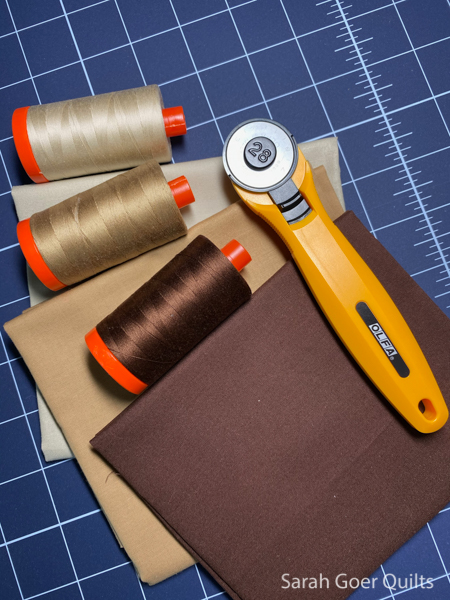
For the challenge I received the Florence Brown Aurifil Color Builder with three large spools of 50wt in Ermine (#2312), Toast (#6010), and Chocolate (#2360), a trio of Michael Miller Cotton Couture fat quarters in Khaki, Ginger, and Brown, an OLFA 28mm rotary blade (with refills), and a 24” x 36” OLFA cutting mat in Navy.

I enjoy planned improv piecing. I start with a set of rules or guidelines. This might be a color palette, a tool, a technique, or something else. My color palette and tools were provided for me. I knew I wanted to add a little bit of another color. Eventually, I landed on improv curves as my plan. (Scroll down for a mini tutorial on how I cut and sew improv curves.)
Initially I was considering a table runner with improv curves in khaki, ginger, and brown and thought I'd appliqué on some leaves in fall colors. I'm not terribly fond of the process of appliqué, so I pivoted to just improv curves. I eventually settled on a two-sided square table topper, because I had just enough fabric to make it entirely from my three fat quarters.
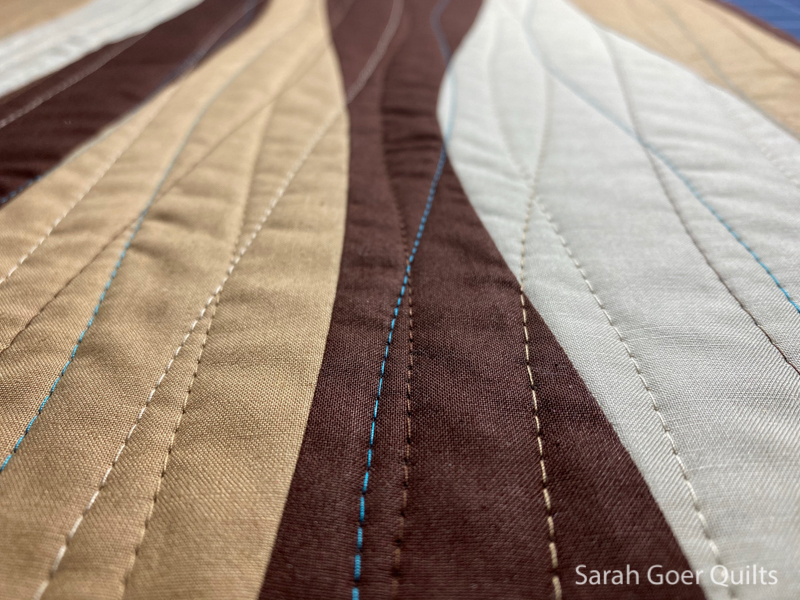
To complement the curved piecing, I opted for organic, curved walking foot quilting in four colors, adding a tiny splash of color with Aurifil 50wt Dark Turquoise (#4182).
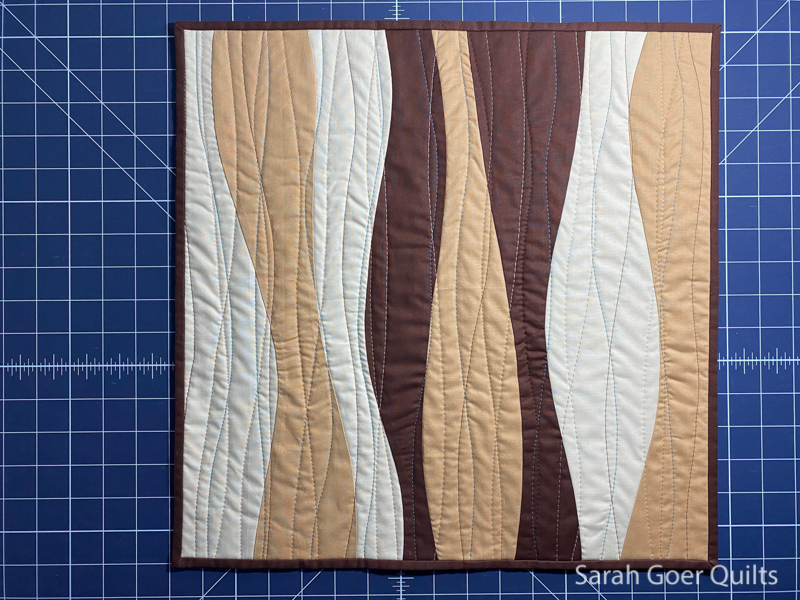
My finished quilt is 16 1/2" x 16 1/2".
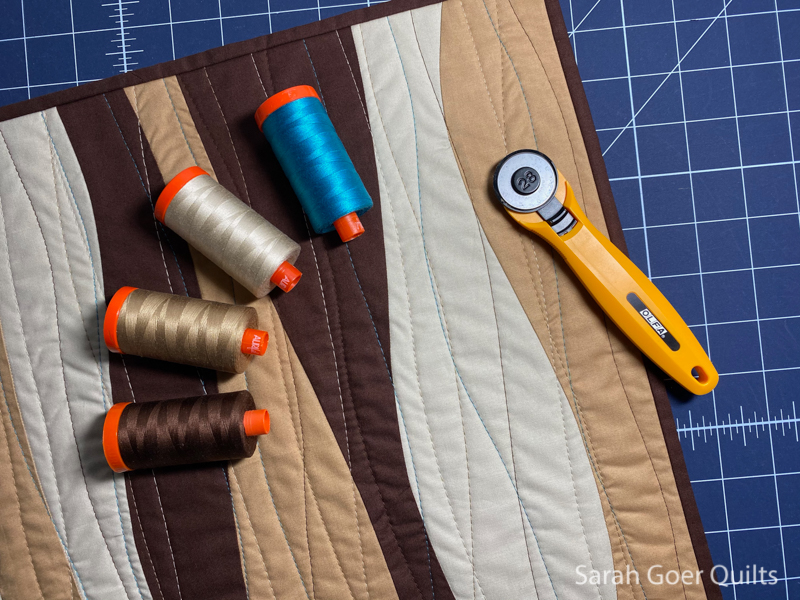
Thank you to Aurifil, OLFA, and Michael Miller for supplying me with everything featured in this quilt.


Improv Curve Tutorial

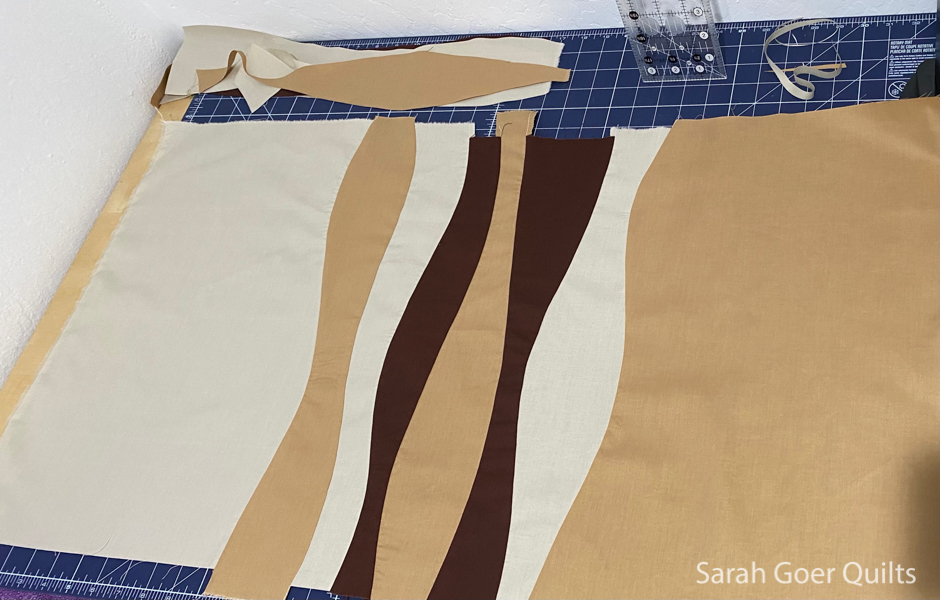
In general when I create improv curve piecing I make units that are oversized and trim them down after piecing. In the third photo from the top of this post above you can see my in progress work on my cutting table. The top and bottom edges are not aligned at all. If I wanted to create an 8" block I would probably start with pieces of fabric that were 10" wide.

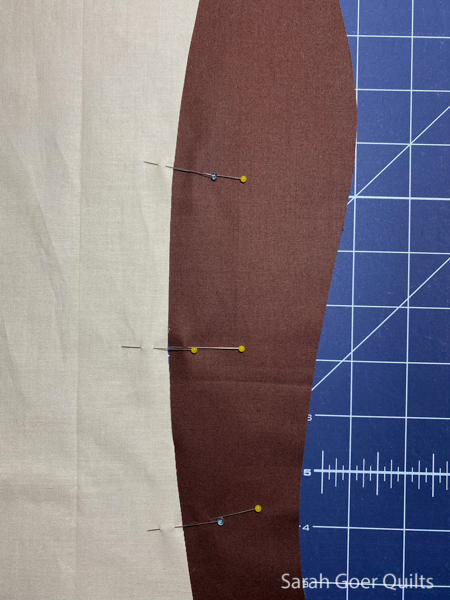
Step 1: Lay two fabrics right side up, overlapping by a couple inches. (Not shown.) Slowly and carefully (keep those fingers out of the way!) cut through both layers with your rotary cutter (but no ruler or template), making a smooth improv curve. Always cut away from you. Remove the edges you've cut off of both fabrics so you have two pieces that fit together like a puzzle with the same curve cut. (This is more easily seen in the step 2 bottom photo below.) Here I have removed a little of the khaki fabric to the right of the cut and the edge of the brown fabric to the left of the cut:
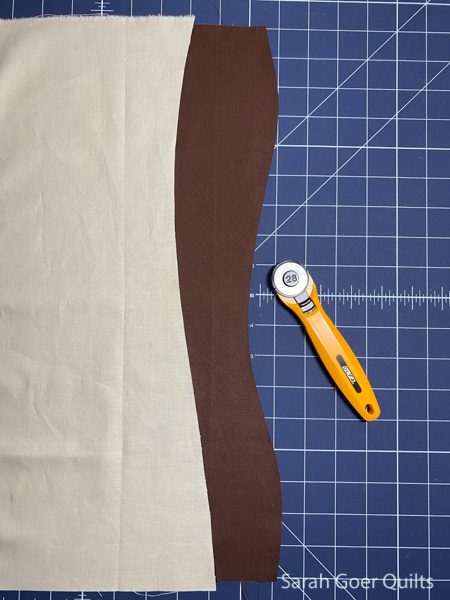
Step 2: Using your marking method of choice, mark points that align on the two fabrics. Here I have chosen to use two straight pins, one in the khaki and one in the brown. These points should line up when piecing the fabrics together. If the fabrics are difference lengths, also mark where the edge of one fabric hits the other. I have not pinned the fabrics together at this point, as you can see in the second photo below.
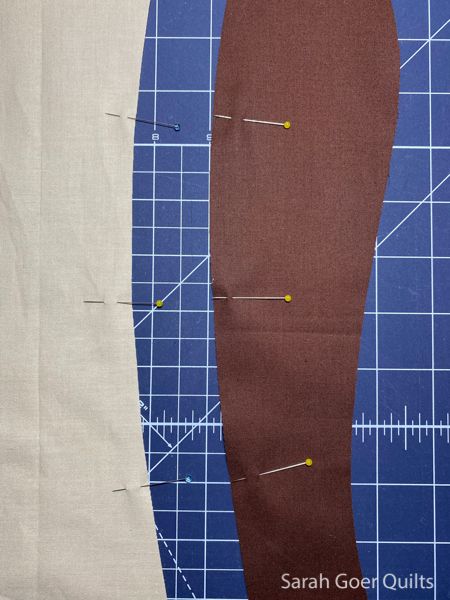
Step 3: Flip the right piece of fabric over and place onto the left piece, right sides together. Use your marks as a guide for pinning the two pieces at those points only. Since I had two pins that were used for marking I have pinned twice at each point. A single pin should work fine as well.
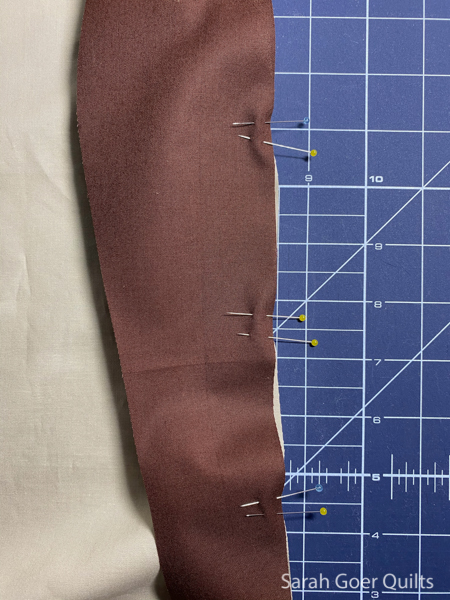
Step 4: Sew with a quarter inch seam allowance. The curved cut gives you a bit of stretch along the edge of your fabric. As you sew, gently stretch the (only the) longer fabric between each pair of pins. This will change depending on which part of the curve you are on. In general, you'll be gently stretching the fabric that has a concave curve in that section. Do not remove pins until you get close to them. Take care to make sure that your bottom fabric is laying flat to avoid puckers. If you are ending up with too much of one fabric when you get close to the pin try stretching the longer fabric a bit more when you sew that section. This part take a little finesse, so practice until you like your results. Smoother, flatter curves will be easier to sew. This technique is not recommended for a drunkard's path 1/4 circle where the two pieces really need to be cut from different templates.

I generally prefer to press my seams open, but improv curves are a time when I press the way the fabric wants to go. If you are using high contrast fabrics you should be able to press to the dark side. And if you want to try it, pressing open can work as well. The seam shown above is the left seam below on the finished back of the quilt.


Sarah is a quilt artist, pattern designer, teacher, and lecturer who is passionate about using bold color and geometric design in both traditional and improv quilts. She enjoys inspiring others in their creativity. As a former math teacher Sarah loves the geometry and math of quilting. She is currently visiting guilds virtually to present lectures and workshops on Zoom. Sarah lives in San Jose, California with her husband and two quilters kids.

Keep up with Sarah by signing up for the Sarah Goer Quilts Newsletter.

4 Comments

We are one week into Quilting the Countdown 100 day project. There are 93 days left until QuiltCon. I'm working on my dormant Patchwork City WIP and it's been exciting to get back to it. My goal is 15 minutes a day, though some days I have worked longer on this project. Here's a glimpse at what I've gotten done this week.

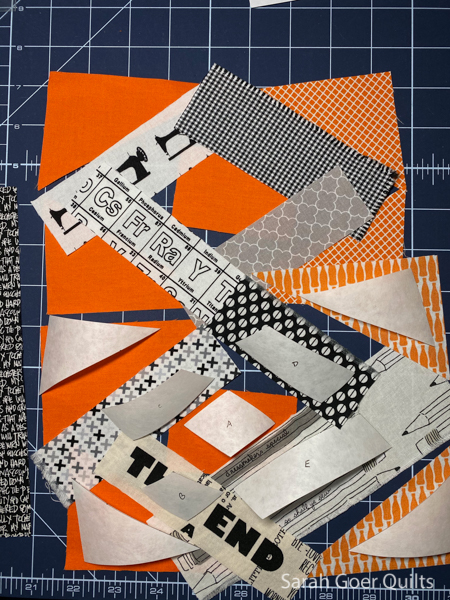
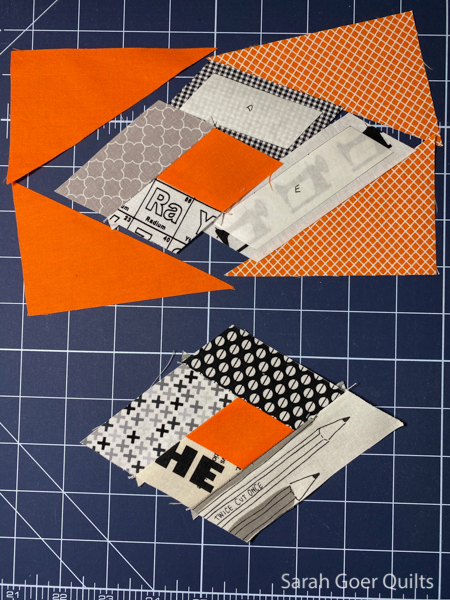
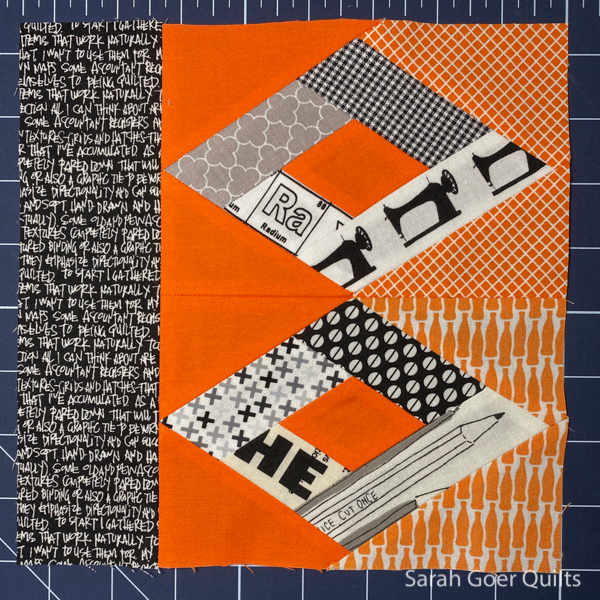
Aided by the fact that I had three blocks precut, I finished two blocks this week, bringing me to 30 out of 75 blocks complete. The blocks shown this week feature Kona Grass Green, Torch, and Cyan. Many of the blocks in this quilt require templates. I'm making mine by tracing onto freezer paper, so I can iron it onto the fabric and trim 1/4" around the template pieces for precision.

One of my favorite tools in my studio is my pile of fast food trays. They are so helpful for keeping the pieces of a block or project together. Though, I think I'm ready to level up to using a sheet pan rack for keeping all the components of a project together on the larger trays.

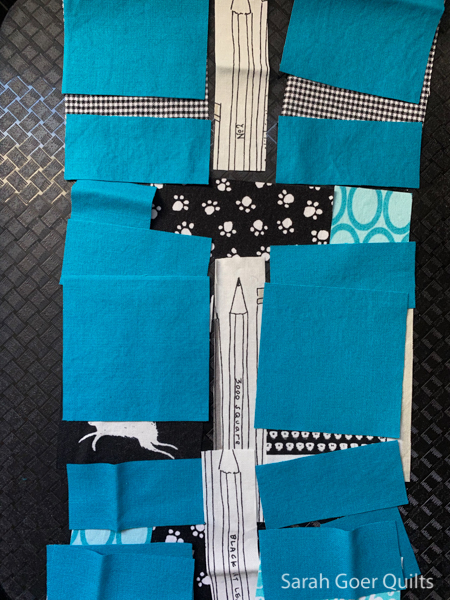
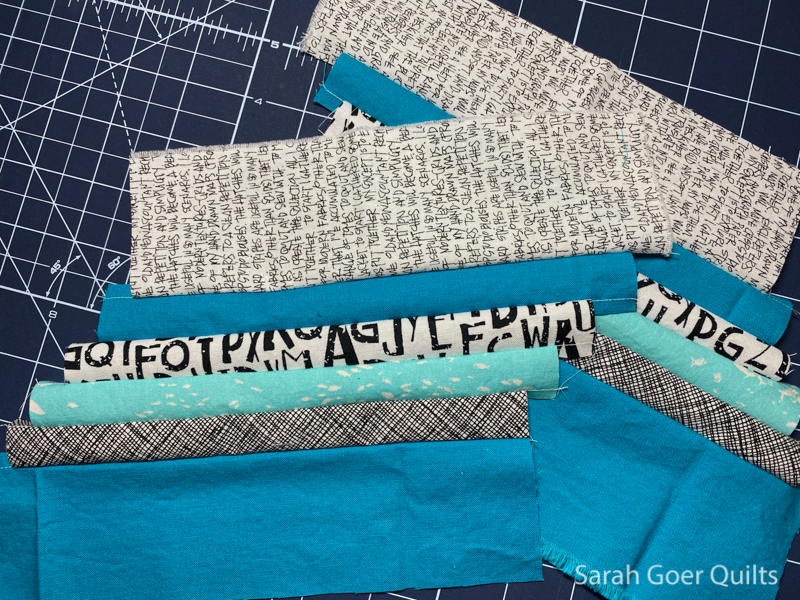
My last (barely) 15 minutes was to sew together these strips (that I'd cut out the previous day). They aren't even pressed. Today I'll be pressing them, cutting them up, and sewing them back together for my next finished block.

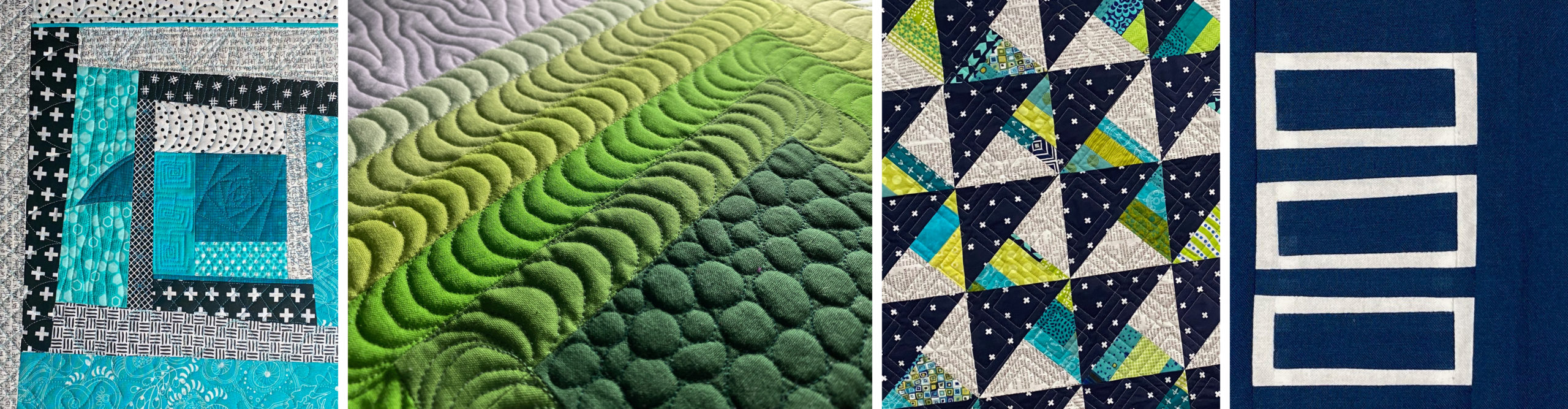
I love the aesthetic of these blocks with black, white, grey, and one color. Black and white prints are a favorite and I'm happy to have a lot of text prints to use in this project. I also like that I can jump around and work on different colors to keep me interested and excited to work on it.

Are you on Instagram? Cassandra is the organizer of Quilting the Countdown. She's making orange triangular blocks and regularly sharing others' projects in her IG stories. Hashtags are a little wonky on IG at the moment, but you may be able to see more at #quiltingthecountdown. The beauty of the countdown is that you can join in whenever you'd like. Start today and do a 93 day project. Or start on day 75, 50, or 25... whatever you'd like! Let me know if you're participating. I'd love to see what you're making.

6 Comments

Tomorrow I'll be starting a new 100 Day Project. (I know! I haven't even shared all the quilts I finished in my last 100 Day Project that wrapped up last month! Stay tuned for those.)

Backstory: I started a 100 Day Project in April and stopped participating after day 49. I had realized that the scope of my initial project was a little too robust for the amount of time I had to actually sew. I'd pivoted a little to finish another project (which fit the technique requirements of my initial plan, generally speaking), and I wasn't really having fun with the project anymore. I am glad I participated. (I'm also glad I stopped.) I made a lot of things I'm excited about, but most importantly it taught me a little about what would work for me in a future 100 Day Project. I have longtime admired the people that make a finished item a day (like a mini quilt or a postcard) for 100 Days. The second time around (July 20 - October 27, 2020) I set myself a more attainable goal: 15 minutes a day working on a series of mini quilts. I wouldn't be cranking out 100 finished items, but I would make progress on creating quilts in a series that I was excited to work on. I'd made the first two in January and February. I shared my green improv log cabin quilt back in September.

I had such a great time with my recent 100 Day Project. I made five 16 1/2" x 16 1/2" improv log cabin mini quilts, start to finish. Some days I worked longer than fifteen minutes and, truth be told, a few days I didn't make it into the studio and felt liberated to make up those sewing minutes the following day. I didn't share on the blog except for that September post, and I only shared a handful of posts on Instagram. But I saw the project through and made five quilts. I'm calling that a win.

I'd been thinking about starting a new 100 Day Project (though I had no specific plan) when I saw Cassandra post on Instagram that she would be starting again on November 10. She encouraged quilters to join in with their own project. She has decided to count down from 100 and is calling it #quiltingthecountdown. I love the quilting community and was excited to join in. I considered another improv project, perhaps one making blocks or units that turned into a finished quilt during the project (like Cassandra's last two projects), but I decided to go another way and pull out a WIP. I'll be spending at least 15 minutes a day working on my Patchwork City quilt. This is a project I started way back in February of 2015! (I wish I could say it's my oldest WIP, but it most certainly isn't.) Recently an IG friend finished up her Patchwork City quilt and I felt a little envious. Today Jessica posted her first Patchwork City block and it made me itch to work on mine. I considered other options and kept coming back to pulling this one off the shelf. So off I go upstairs to pull the project out and make a plan for myself for tomorrow. If I remember correctly I have some blocks cut out and ready to piece together. (Score!) If by chance, this quilt gets finished before I countdown to Day 1, I'll choose another WIP to work on for the remainder of the project.

This time around I plan to share weekly updates on my blog. I'll share some process photos on Instagram as well. Click for a peek at some of my first finished blocks.

Have you ever done a 100 Day Project (quilting or otherwise)? There's still time to participate with us. Join us over at Instagram with the #quiltingthecountdown hashtag. Tuesday, November 10 is Day 100 on our countdown.